
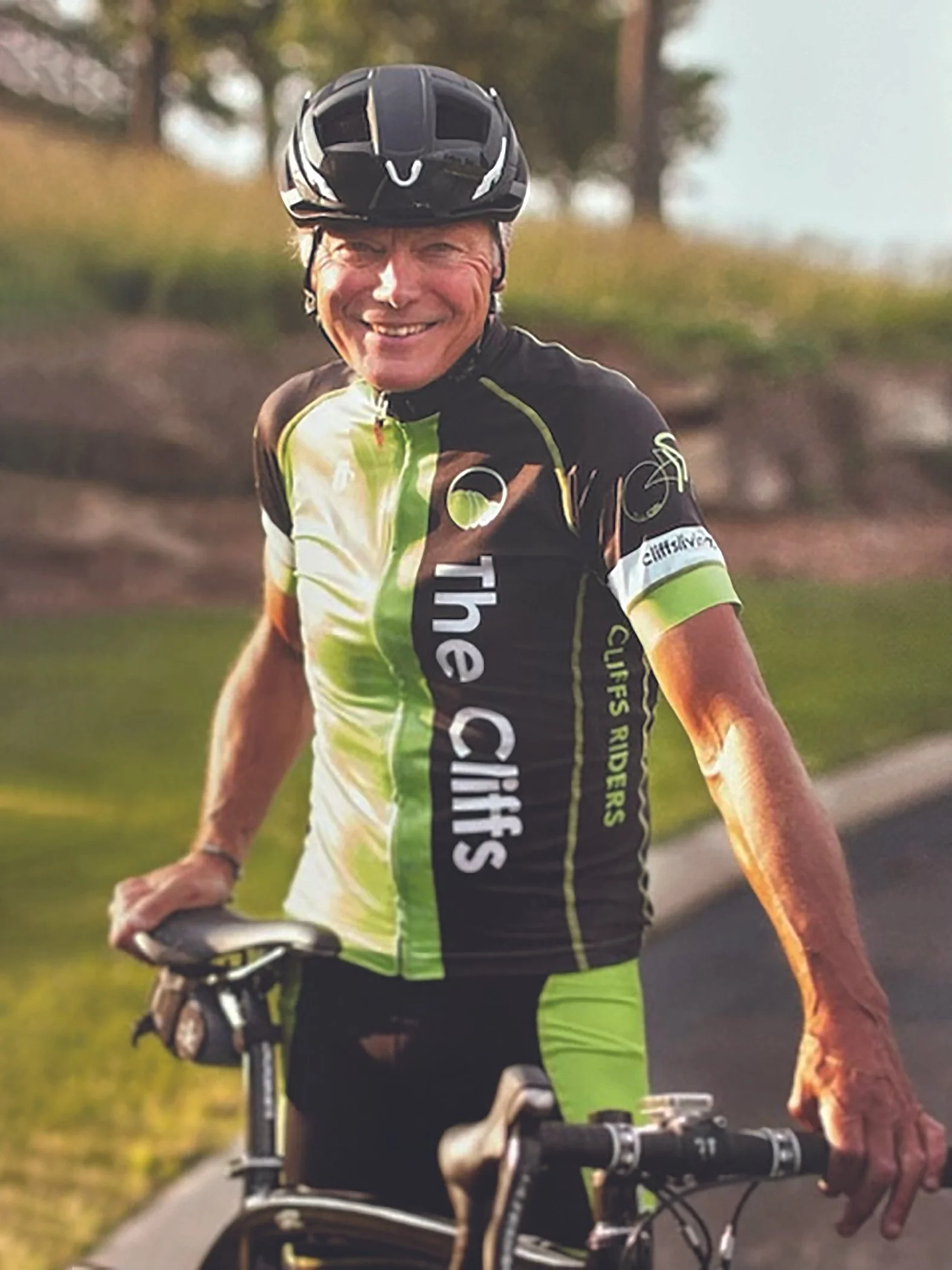
Career Highlights
International cycling competitor – 1973-1977
Raced in: Canada, Chile, Ireland, Mexico, South Africa, United States routes
Member of prestigious Century Road Club of America-Raleigh Team
Highest Olympic development points total, East Coast – 1976
Alternate, 1976 Olympic team
Certified USA Cycling coach, junior riders ages 14-18
Olympic torch relay coordinator (cycling), Los Angels to Atlanta – 1996

Richard “Dicky” Dunn
Pedal pusher: International cyclist Dicky Dunn has seen the world, one ride at a time
Richard “Dicky” Dunn got his first bicycle when he was 5, a big-tire, red Schwinn. His driveway on Norton Road in Mount Holly became his personal starting line for childhood road courses through playgrounds, ballfields, nearby towns and big cities a half-day away.
“I rode all around Mount Holly and mastered that; then when I got older, I started venturing off to Belmont and rode to Stanely and Lucia, and then I rode to Charlotte and to Gastonia,” he says. “I played all the traditional ball sports, but I always rode my bike to practice and rode it home, rode my bike to the swimming pool, to the movies, to the Gastonia theater. It was just a natural thing.”
When he got his drivers license, Dunn says, he put the kickstand down. Briefly.
“It was for about a year,” he says. “Then I went back to the bike. After I really started racing and training, my training route was Mount Holly to Stanley, then over Spencer Mountain to Gastonia, then down to New Hope Road to Cramerton, then back through Belmont to Mount Holly.”
The latest stop for Dunn, 73, is a spot in the Mount Holly Sports Hall of Fame.
Dunn made cycling his life. He’s competed in road races around the globe, been a member of prestigious racing clubs, managed camps for USA Cycling, coordinated the Olympic torch relay from Los Angeles to Atlanta in 1996 and was an alternate on the 1976 US Olympic team. Canada, Ireland, Mexico, South Africa … been there, rode that.
“At the time, it’s just what I did, but in my older age it’s like, ‘I really did that?’” he says.
His longest race was from Quebec City to Montreal, 175 miles nonstop. “It’s continual, and the first rider wins the race,” he says. “If you have to stop for whatever reason, a mechanical issue or nature break, you lose time and you either catch back up, or you don’t.”
Dunn attended Mount Holly High School, then Hendersonville’s Blue Ridge School for Boys for a year (“It turned me away from being an academic disaster. Some people just have to actually study, I guess.”), back to Mount Holly High (Class of 1970), Mitchell Junior College and UNC Charlotte.
He heard of a bike race in Columbia, Md., and drove himself there in May of ’73. He was 21.
“So, I do the race, and it’s raining the whole race and it’s a tight criterium, and I do really well – a little aggressive – and I’m back in the parking lot and this older fellow comes up to me and I’m like, ‘Who’s that?’ and it’s Fritz Kuhn of the Century Club wanting me to join his club. He was like the godfather of Eastern cycling, had a shop in Princeton, N.J., and I thought ‘Oh, my gosh.’ So, I was on the team and pretty much from that point on, I was racing around big cities in the South.”
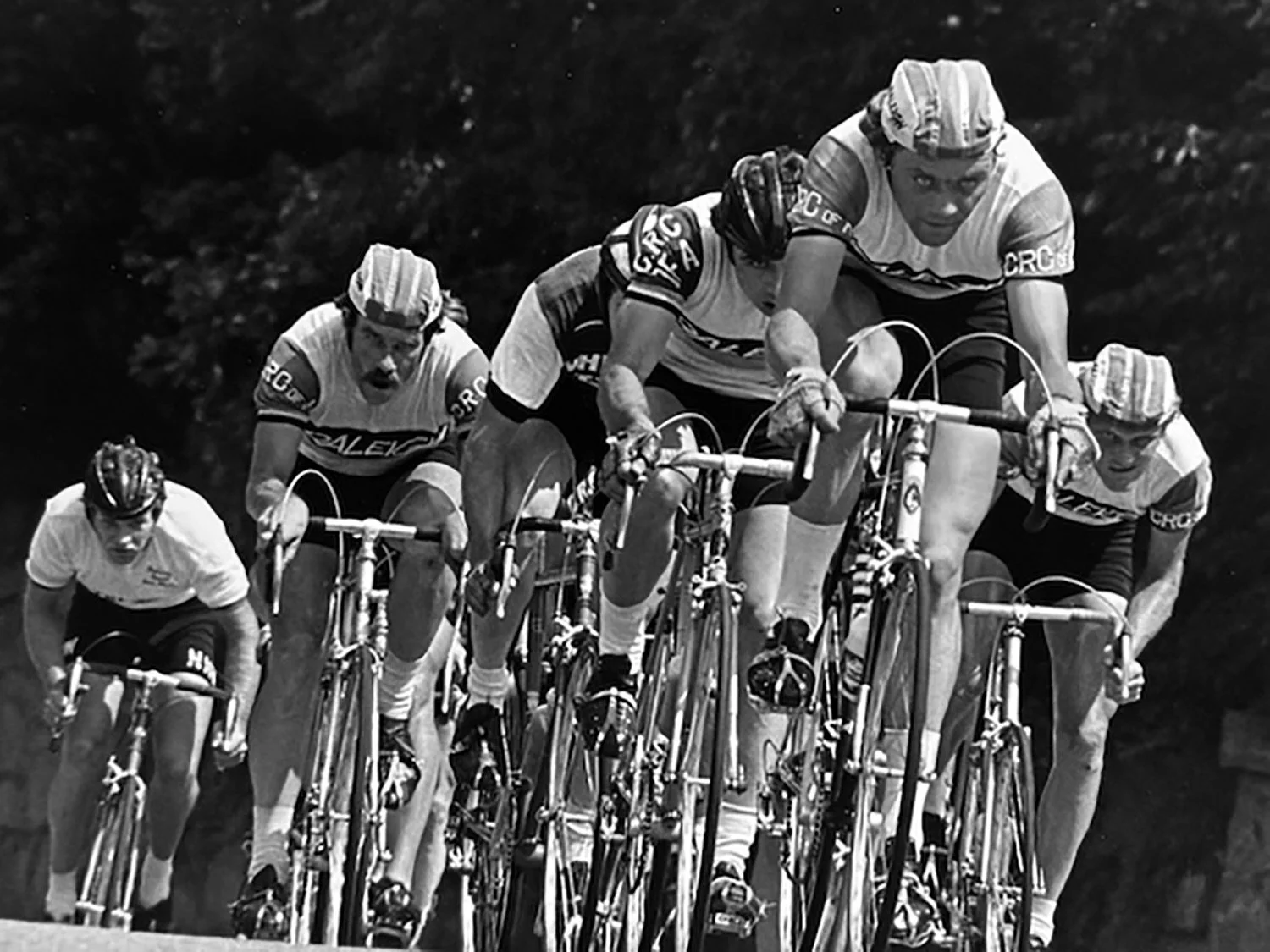
“The Century team (Century Road Club of America, or CRC of A) is the oldest cycling club in America, and it’s based in Princeton and everyone in that area wanted to join,” says former teammate Bill Humphreys, 80, who still competes. “But Dicky was recruited by them. There’s a difference. He was a top talent, so he was on their A team.”
Dunn raced throughout the South, then in ’74 went to Cambridge, Mass., home base for the Raleigh-Century Road Club of America (Raleigh brand bicycles were a sponsor), where he was on a 15-member team.
“That, from Mount Holly to Cambridge, Mass., was like ‘kaboom.’ Raleigh Bicycles was based in Boston, so you’re in the South, and now you’re in the heart of New England,” he says. “But I’m an adaptable person.”
Cycling in the late 1970s, Humphreys says, was evolving from relative obscurity to being launched into the media spotlight. “America wasn’t paying attention, but we were getting results and getting medals in Europe,” Humphreys says. “Dicky raced the Tour of Ireland, eight days and 750 miles, and he raced in Mexico and he raced in Chile and in Canada and all over the United States, so we didn’t have much of a home then. We were living on the road and racing all the time.”
Dunn raced throughout New England, then went to Superweek in Chicago, a multi-day race formerly known as the International Cycling Classic, and was selected to do the Tour of Ireland, where he finished 11th.
Cyclists know that the term Tour in a race name doesn’t mean being able to see the location, like a tourist.
“You’re really focused on the racing. We did a general tour, a little bit around Dublin, but racing is hard,” he says. “You race, get cleaned up, go to bed. Then you travel to the next event and try to stay rested.”
In 1975, Dunn was selected to go to South Africa with the CRC-A team, as was Humphreys.
During practice two days before the Cape Town race, known as the Tour of the Winelands, Dunn was hit head-on by a car. He was hospitalized for a month.
“I had plaster from my ankles to my thighs. I had chips in my knees and severed a tendon below my right knee. I almost had to learn to walk again,” he says.
The return trip to the States was almost reminiscent of his childhood trips around the far reaches of Gaston County. It was not a direct route.
“This was before nonstop mega-flights. So I had to go from Cape Town to Johannesburg to Zaire to Rome to Milan to JFK to a taxi ride to LaGuardia then fly to Charlotte,” he says.
The memorable part of that journey, he recalls, is the sportscar.
“The Cape Town to Johannesburg part was delayed by weather, so I’m trying to get to where my connection is in Johannesburg and I’m late. I didn’t realize how late I was,” he says, “and they said the plane was already taxiing out. And I’m like, ‘So what am I going to do?’ And they stopped the 747 on the runway, put me in this little Fiat and drove me out to the plane, and they lowered the stairway down and I get on the plane, and they retrieve the stairway and shut the door and everyone’s looking at me. And I’m like, ‘Welp, here I am.’ You’d never be able to do that now.”
Dunn was determined to ride again. His father made arrangements with Belmont Abbey to let him run on their track. He worked his legs, his strength. Five months later, he was racing in Ireland in an eight-day international stage race.
In 1976, he started racing his way up the East coast, starting with Florida races in Orlando, Miami, Gainesville, Jacksonville and Tallahassee, then up the coast and back to Charlotte and Lexington, back up to New Jersey and Allentown, Pa., then in Vermont. There were Olympic development selection races, he says, with the nation divided into thirds – East, Central and West, and Dunn had the highest Olympic development points on the East coast. “So I was the number one rider in the East in 1976. I came as close as you can possibly come to making it,” he says.
He was one of two Olympic alternates for the Montreal Games.
He slowed a bit after that, schedule wise. “I stopped my real racing days,” he says. He raced an event in Baja, Mexico, and later, one in New York. “My focus changed,” he says.
He married Christal, who he met in Asheville, and started doing Masters racing, promotions and coaching, and working at the Grove Park Inn. He promoted the French Broad Cycling Classic and other events and was cycling coordinator for the Olympic torch relay from Los Angeles to Atlanta for the 1996 Games. He and Christal have a son, Matthew, and daughter, Kelly.
Life stayed in a lower gear awhile until Dunn was invited to what he refers to as “the funniest ride I’ve ever been on.” Through media contacts for an Asheville race, he learned that late comedian Robin Williams – a cycling enthusiast – was in town filming Patch Adams.
Williams wanted to go for a ride.
“His assistant said to meet them at the Folk Art Center – Blue Ridge, and I met Robin there and his assistant,” Dunn says. “And the assistant asked if he should follow us, and Robin said no. So it was just Robin, myself and my son, and he was so funny. He was an avid cyclist and he owned more than 100 bicycles. He said they were a lot cheaper than cars. We were just hanging out, talking. I have a photograph of us, the best selfie I’ve ever taken.”
In October 2023, Dunn was part of the CRC-A Raleigh receiving a Special Recognition with the USA Bicycling Hall of Fame.
Dunn still rides, usually in the afternoon, about 15 miles or so.
“I try to ride 360 days a year,” he says. “The bike has always been my friend.”